
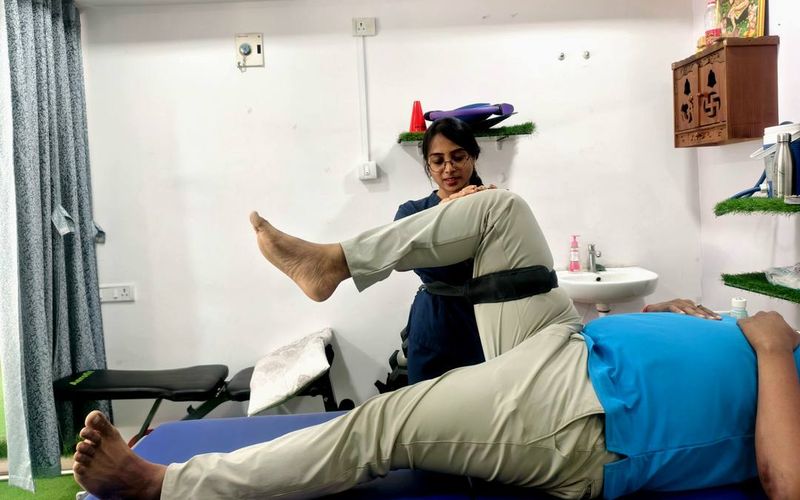
Physiotherapy after a knee replacement usually starts within a day of surgery, in hospital. Over the next 6 to 12 weeks, the goals are to straighten the knee fully, bend it past 90 and then towards 110–120 degrees, walk without support, and manage stairs. Most people need about 15 to 30 sessions plus daily home exercises, and full recovery takes 6 to 12 months.
The call came from a conference room in Gachibowli. You could hear the projector fan in the background.
"Madam, my father had his knee replacement surgery last week at a hospital near Banjara Hills. They discharged him yesterday. The hospital physio showed him some exercises, but now he's at home in Madhapur, he's scared to walk, and my mother is calling me every hour. What do we do now?"
Let's call his father Ramana Rao garu. He's 68, a retired bank officer who spent ten years limping with knee arthritis before finally agreeing to surgery. And his son's question, "what do we do now?", is the question almost every family asks in the week after discharge. The surgery is done by a surgeon in a few hours. The recovery is done by the patient and the family over months, and that part is mostly physiotherapy.
So here's the week-by-week plan I walk families through, including the very Indian questions that most foreign websites never answer: Can he sit on the floor for pooja? What about an Indian toilet? When can he climb the stairs in our apartment?
How soon does physiotherapy start after knee replacement?
Within 24 hours of surgery, usually. In most Hyderabad hospitals, the physiotherapist will have you sitting up, standing and taking a few steps with a walker on day one or day two. It feels too early. It isn't. Getting moving early reduces stiffness, swelling and the risk of blood clots.
The tricky part is after discharge. In hospital, someone comes to your bed and tells you what to do. At home, nobody does, and that's where many people lose ground.
Knee replacement recovery timeline: week by week
| When | Main goals | Walking | Bend target* |
|---|---|---|---|
| Day 1 – 3 (hospital) | Stand, walk short distances, ankle pumps, tighten the thigh muscle, control pain | Walker, with help | Gentle bending begins |
| Week 1 – 2 (home) | Get the knee fully straight, control swelling, walk around the house several times a day | Walker | About 70 – 90° |
| Week 3 – 6 | Keep straightening, bend more, strengthen the thigh, stairs one at a time, short walks outside | Walker → walking stick | 90° and beyond, towards 110° |
| Week 6 – 12 | Walk without support, balance, longer walks, getting up from low chairs, return to light routine | Usually no support | About 110 – 120° |
| 3 – 6 months | Strength and stamina, longer walks, normal daily activity | Normal walking | Gains slow down |
| 6 – 12 months | Final settling: swelling and warmth fully go, the knee stops 'feeling new' | Normal | Mostly reached |
At PAL we usually see patients about three times a week for the first six weeks, then twice a week, then taper off as the home programme takes over. Some people need more, some less.
The two exercises that matter most after knee replacement
If you remember nothing else from this post, remember these two. One fights the knee getting stuck bent. The other fights it getting stuck straight.
1. Straightening: quad sets and heel props
Sit or lie with your leg straight and a rolled towel under your heel, not under the knee. Tighten the muscle on the front of your thigh, pushing the back of the knee down towards the bed. Hold 5 seconds, relax. Do 10, several times a day. Also spend a few minutes, a few times a day, with the heel propped on the towel and the knee hanging straight.
Never sleep with a pillow under the knee after a knee replacement. It feels comfortable, but it lets the knee stiffen in a bent position. A knee that won't straighten fully makes you limp for a long time. A pillow under the heel is fine.
2. Bending: heel slides
Lying on your back, slowly slide the heel of the operated leg towards your bottom, bending the knee as far as you comfortably can. Hold, slide back. Ten slowly, several times a day. Later you'll do the same sitting on a chair, sliding your foot back under it.
The rest of the home programme
- Ankle pumps: point and flex the feet, 20 times every hour you're awake. Great for circulation.
- Straight leg raises: tighten the thigh, then lift the straight leg a hand-width off the bed.
- Short arc quads: a rolled towel under the knee, then straighten the lower leg and hold.
- Sitting knee bends: sitting on a chair, bend the knee back as far as comfortable.
- Later: mini squats holding a counter, step-ups, and balance work.
Ice for 15 to 20 minutes after exercising helps with swelling. Wrap it in a cloth, and keep the wound dressing dry.
After knee replacement, when can I climb stairs?
Most people manage stairs, one step at a time with a railing, before they leave hospital or within the first week or two at home. The rule is 'up with the good, down with the bad': lead with your good leg going up, and with the operated leg going down. Stairs one-foot-after-the-other usually comes back around 6 to 12 weeks.
In Hyderabad apartment complexes, my advice is simple: use the lift for the first few weeks when it's there, and practise stairs a few steps at a time as an exercise, not as your main way in and out. If you live in an independent house with stairs to the bedroom, it's often easier to sleep downstairs for the first two weeks.
After knee replacement, can I sit on the floor, squat or use an Indian toilet?
This is the question foreign websites never answer, and it matters hugely here: pooja, family meals on the floor, the Indian-style toilet at your native place.
In the early months, no deep squatting, no sitting cross-legged on the floor, and no Indian-style toilet. Use a western commode, or a commode chair or raised seat over an Indian toilet. Whether you can sit on the floor long-term depends on your implant and your surgeon's advice, so ask them directly. Many people manage comfortably with a low stool instead.
Most knee replacements comfortably reach around 110 to 120 degrees of bend. Sitting cross-legged or squatting needs much more than that, plus twisting, which puts a lot of strain on the new joint. Some newer "high-flex" implants allow more bending, but please don't experiment. Ask your surgeon what's safe for your knee.
Padma garu, 64 (not her real name), from Kondapur, told me on her first visit: "Amma, if I can't sit for pooja, what is the use of this new knee?" We set it up so she could do pooja sitting on a low wooden stool, with her legs comfortably out, and a cushion. Three months later she sent us a photo from her granddaughter's naming ceremony, sitting on that stool in a silk saree. She was very happy. So was I.
Is physiotherapy at home enough after knee replacement?
For the first one to three weeks, home physiotherapy is often the right choice, because travelling is tiring and you're still on a walker. We offer home visits for exactly this stage. After that, coming to the clinic is usually better: we have equipment for strength, balance and range that doesn't fit in a living room, and the outing itself is good practice.
What's not enough is doing nothing between visits. The exercises you do at home, several times a day, are where most of the recovery actually happens. The sessions guide and progress them.
Warning signs: when to call your surgeon
Call your surgeon or go to the hospital if you notice:
- Pain, swelling or warmth in the calf, which can be a blood clot
- Chest pain or sudden breathlessness. Go to emergency immediately.
- Fever, or redness, discharge or a bad smell from the wound
- A sudden big increase in pain or swelling, or the knee suddenly feels unstable
Getting your Hyderabad home ready before (or right after) surgery
- A western commode, or a commode chair or raised seat if you only have an Indian toilet
- Grab rails in the bathroom, and a plastic chair in the shower area
- Remove loose floor mats and rugs. They're the number one tripping hazard with a walker.
- A firm chair with armrests, not a low sofa
- A night light on the way to the bathroom
- An ice pack or two in the freezer
Two-wheelers and cars
No riding pillion on a two-wheeler until your surgeon clears you. Getting on and off, plus Hyderabad's speed breakers, is a real fall risk in the first couple of months. Driving a car usually comes back around 4 to 6 weeks for a left knee in an automatic, and later for a right knee, but only once your surgeon agrees and you can brake hard without pain.
How many physiotherapy sessions after knee replacement, and what does it cost?
Most people need about 15 to 30 sessions over 6 to 12 weeks, sometimes more if the knee was very stiff before surgery or recovery is slower. For what that adds up to in rupees, and how home visits compare with clinic sessions, see my guide to physiotherapy cost in Hyderabad.
What happened with Ramana Rao garu?
Weeks 1 and 2: home visits. His knee was stuck about 15 degrees short of straight, because he'd been sleeping with a pillow under it (of course). We fixed that first. His wife became the best exercise supervisor I've ever had.
Weeks 3 to 6: he started coming to our Madhapur clinic, first with the walker, then with a stick. He climbed the 12 steps to his first-floor flat, one at a time, in week four.
Week 10: walking to the temple at the end of his lane without a stick, about 112 degrees of bend, and a lot of opinions about the cricket on our clinic TV.
His son told me the best part was that his mother stopped calling him at work every hour.
Knee replacement physiotherapy in Madhapur, Kondapur and nearby
We see knee replacement patients at our two clinics in Hyderabad, Telangana, open every day from 7 AM to 9 PM, and we do home visits in the early weeks:
- Madhapur, Vittal Rao Nagar: convenient for HITEC City, Jubilee Hills, Kavuri Hills and Ayyappa Society
- Kondapur, Sri Ramnagar Block C: convenient for Kothaguda, Gachibowli, Hafeezpet and Raidurg
Key takeaways
- Physiotherapy starts within a day of surgery, and the weeks after discharge decide how well you recover.
- Getting the knee fully straight matters as much as bending it. No pillow under the knee.
- Expect 15 to 30 sessions over 6 to 12 weeks, and 6 to 12 months for full recovery.
- No deep squats, cross-legged sitting or Indian toilet early on. Ask your surgeon about floor sitting long-term.
- Calf pain, chest pain, breathlessness or fever means call your surgeon straight away.
Services that help after knee replacement
Talk to us about your knee replacement recovery
We're open every day, 7 AM to 9 PM, in Madhapur and Kondapur. Tap to call, or get directions straight to the clinic.
Madhapur: Plot No. 1-89/A/3/15, Vittal Rao Nagar · Kondapur: Street No. 11, Sri Ramnagar Block C, beside Charminar Biriyani
The patient stories in this article are composites of the kinds of cases we see every week at our clinics; names and identifying details have been changed for privacy. This article is general information and isn't a substitute for an in-person assessment. Last reviewed: October 27, 2026.