
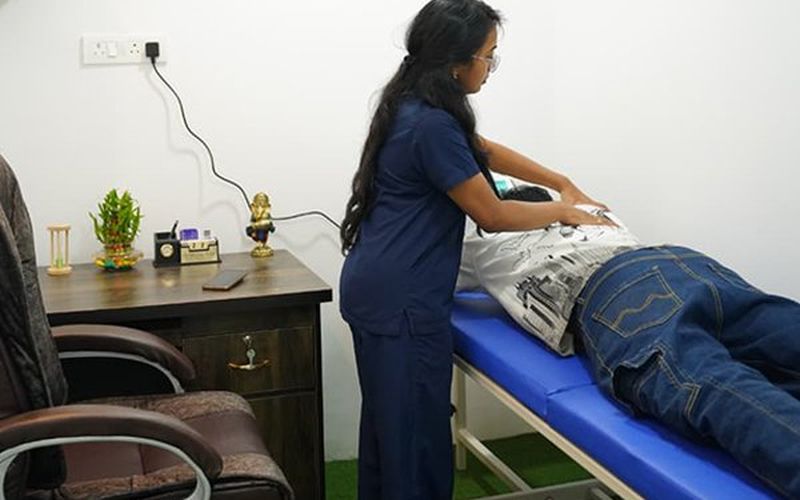
For most back, neck, shoulder or knee pain that came on without a major injury and has no red-flag symptoms, a physiotherapist is a sensible first stop. You don't need a referral. See an orthopaedic doctor first after a fall or accident, if you might have a fracture, or if you have red flags like leg weakness, numbness in the groin, or bladder changes. In India, 'chiropractic' is usually spinal manipulation, and it's safest when it's done after a proper assessment by a qualified professional.
A WhatsApp message I got last month, more or less word for word:
"Hi ma'am. Lower back pain for 3 weeks, sometimes going into my right leg. My colleague says go to ortho and get an MRI. My cousin says go to a chiropractor, he cracked his back and was fine in one session. My mom says physio. Who should I go to?? 😭"
It came from a 31-year-old product designer in Raidurg. Let's call her Meghana. And honestly, her confusion is completely fair. Even big Hyderabad hospital websites give different answers to this question. Some say start with a general physician, some say go straight to a spine surgeon, and meanwhile the surgeons themselves say most back pain doesn't need surgery.
So here's how I'd think about it if I were in your shoes, and it's the same way I explained it to Meghana.
Physiotherapist or orthopaedic doctor: who should I see first?
Think of it like this. An orthopaedic doctor is the specialist who diagnoses with scans, prescribes medicines, gives injections and does surgery. A physiotherapist is the specialist in how your body moves, who treats pain and stiffness by restoring movement, strength and control, without medicines or surgery.
Most everyday musculoskeletal pain, like a stiff neck from your laptop, back pain from sitting, a twisted ankle, a sore knee from running or a painful shoulder, is a movement problem. That's why a physiotherapist is usually the right first stop. And if something needs a scan or a surgeon, a good physio will spot it and send you there. That's part of our job.
Your symptom → who to see first
| If you have… | See first | Why |
|---|---|---|
| Back or neck pain from sitting, posture or a minor strain | Physiotherapist | Movement problem; most improves without scans or medicines |
| Sciatica (leg pain) without weakness or numbness | Physiotherapist | Most sciatica settles with physiotherapy and time |
| Sciatica with worsening leg weakness, foot drop or groin numbness | Orthopaedic / spine doctor, same day | Possible serious nerve compression |
| Neck pain with arm numbness or weakness | Doctor first, then physio | Needs a nerve check, and maybe a scan |
| Ankle sprain, muscle pull, sports niggle | Physiotherapist | Unless you can't put weight on it at all, which needs an X-ray |
| Fall or accident, possible fracture, can't bear weight | Orthopaedic doctor / emergency | Rule out a fracture first |
| Knee arthritis pain | Physiotherapist, with ortho if severe | Strength and movement help most people; surgery only for advanced cases |
| Frozen shoulder | Physiotherapist | Physio is the main treatment; ortho if an injection is needed |
| After surgery (knee replacement, ACL, spine) | Both | Your surgeon guides the limits, your physio does the recovery |
Red flags: when to see a doctor (not a physio) first
Please skip the physiotherapy appointment and see a doctor, or go to emergency, if you have any of these:
- Numbness in the groin or "saddle" area, or new bladder or bowel problems
- Leg or arm weakness that's getting worse
- Pain after a fall, accident or injury, or you can't put weight on the leg
- Back pain with fever, unexplained weight loss or a history of cancer
- Severe pain at night that doesn't change with position
- Left shoulder or arm pain with chest pain, sweating or breathlessness. That can be the heart, so go to emergency.
Physiotherapist vs chiropractor: what's the difference in India?
This is where it gets a bit murky, so let me be very clear and honest.
In India, there's no recognised Indian degree in chiropractic. People who call themselves chiropractors here are usually either trained abroad, or are physiotherapists, and sometimes others, who've done short courses in manipulation techniques. Physiotherapy, on the other hand, is a recognised healthcare profession with a 4.5-year bachelor's degree (BPT), optional 2-year master's specialisations (MPT), and national regulation under the National Commission for Allied and Healthcare Professions Act, 2021.
What people usually mean by "chiropractic" is spinal manipulation: a quick, controlled thrust to a joint, often with that famous "crack" sound. Here's what you should know about it:
- The crack is gas, not a bone "going back into place". It's the same as cracking your knuckles. It isn't proof that anything was fixed.
- Manipulation can genuinely help some back and neck pain, especially early on, by easing stiffness and pain.
- But it's rarely enough on its own. Feeling great right after one session is common. Staying great needs strength, movement and habit changes.
- Neck manipulation carries rare but serious risks, so it should only be done after a proper assessment that rules out red flags, by someone qualified to do that assessment.
So what do we do at PAL?
We do offer chiropractic-style treatment and spinal manipulation, because for the right patient they help. But I want to be transparent: at PAL, these techniques are performed by our qualified physiotherapists, after a full assessment, and always as part of a plan that includes exercise. We're physiotherapists who use manipulation, not chiropractors.
| Physiotherapist | Orthopaedic doctor | “Chiropractor” in India | |
|---|---|---|---|
| Training | BPT (4.5 yrs), often MPT (2 yrs) | MBBS + MS / DNB Orthopaedics | No recognised Indian degree; foreign-trained or short courses |
| Diagnoses movement problems | Yes | Yes | Varies |
| Orders scans, prescribes medicines | No | Yes | No |
| Surgery or injections | No | Yes | No |
| Exercise and rehab programmes | Yes, the core of the job | Usually refers to physio | Varies |
| Spinal manipulation | Yes, if trained | Rarely | Main technique |
Is a physiotherapist a doctor?
Fair question, and I'll answer it straight. A physiotherapist is not an MBBS medical doctor. We don't prescribe medicines and we don't do surgery. We're independent healthcare professionals, trained specifically in diagnosing and treating problems of movement, muscles, joints and nerves, and you can see us directly, without a referral. When a problem needs medicines, scans or surgery, we work with doctors.
Physiotherapy vs massage: what's the difference?
A good massage can feel wonderful and relax tight muscles, and I'm all for it. But it's not treatment. A physiotherapist diagnoses why something hurts and then uses hands-on techniques, exercise and education to fix the cause and stop it coming back. If your neck feels great after every massage but the pain is back by Wednesday, that's your answer.
Which doctor should I consult for back pain, sciatica, muscle pain or spondylitis?
| Problem | Start with | Go to the doctor if… |
|---|---|---|
| Lower back pain | Physiotherapist | Red flags, a fall, fever, or no improvement in 4–6 weeks |
| Sciatica | Physiotherapist | Leg weakness, groin numbness, bladder or bowel changes |
| Muscle pain or strain | Physiotherapist | Severe bruising and swelling, or you can't use the limb |
| Cervical spondylosis / neck pain | Physiotherapist | Arm weakness, clumsy hands, or balance problems |
| Lumbar spondylosis | Physiotherapist | Pain or numbness in both legs when walking |
| Joint pain with swelling in many joints | Doctor (rheumatology) | That's the first stop here, not physio |
How physiotherapists and orthopaedic doctors work together
It's not a competition. On a normal week at our Madhapur clinic, we'll refer a couple of patients to orthopaedic and spine doctors, because something in the assessment worried us, and we'll receive a whole stream of patients from surgeons, mostly after knee replacements, ACL reconstructions and spine surgery. The best outcomes I see come from that teamwork.
What happened with Meghana?
She came in to our Madhapur clinic the next evening after work. No red flags: her reflexes, strength and sensation were all normal. Her leg pain changed with posture, which is a good sign. It was a disc irritation from long sitting, made worse by a new 40-minute two-wheeler commute.
No MRI needed at that point. We did some gentle spinal mobilisation (yes, including one manipulation, which she found very satisfying), but the real work was exercises, a fixed desk setup and a cushion for the bike.
Five weeks later she was pain-free. Her cousin still swears by his one-session chiropractor. Her mom, she says, is very smug.
Not sure where to start? Talk to us
If you're in Madhapur, Kondapur, HITEC City, Gachibowli, Kothaguda or nearby in Hyderabad, Telangana, you can come straight to us. No referral needed. If we think you need a doctor or a scan first, we'll tell you, and we won't charge you for treatment you don't need.
Key takeaways
- For most everyday back, neck, shoulder and knee pain without red flags, a physiotherapist is a good first stop. No referral needed.
- See a doctor first after an injury, with a possible fracture, or with red-flag symptoms.
- India has no recognised chiropractic degree. Manipulation is safest after a full assessment by a qualified professional.
- At PAL, manipulation is done by qualified physiotherapists, as part of a full plan.
- Physios and orthopaedic doctors work best together, not instead of each other.
Services mentioned in this guide
Talk to us about your pain
We're open every day, 7 AM to 9 PM, in Madhapur and Kondapur. Tap to call, or get directions straight to the clinic.
Madhapur: Plot No. 1-89/A/3/15, Vittal Rao Nagar · Kondapur: Street No. 11, Sri Ramnagar Block C, beside Charminar Biriyani
The patient stories in this article are composites of the kinds of cases we see every week at our clinics; names and identifying details have been changed for privacy. This article is general information and isn't a substitute for an in-person assessment. Last reviewed: October 27, 2026.