
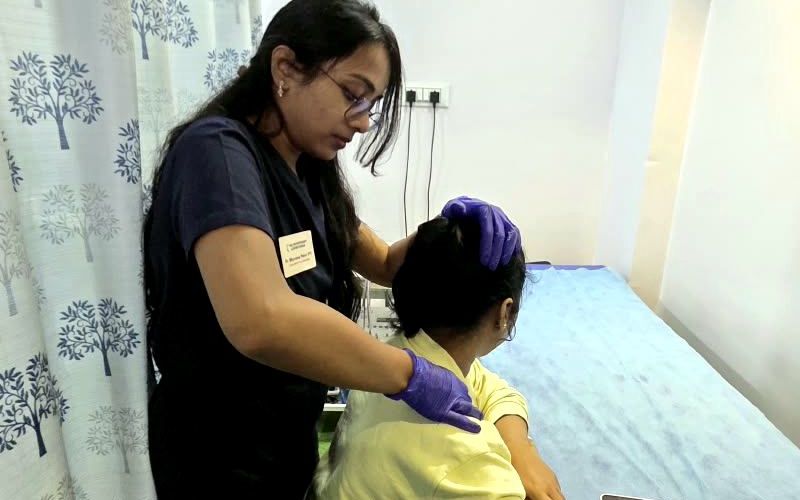
Frozen shoulder (adhesive capsulitis) is when the capsule around your shoulder joint becomes inflamed, thick and tight, so the shoulder gets painful and then stiff. It goes through three stages, freezing, frozen and thawing, and without treatment it can take 1 to 3 years to settle. Physiotherapy doesn't magically skip the stages, but it reduces pain, protects your movement and gets you back to daily life much sooner. It's more common, and slower, if you have diabetes.
"Ma'am, I can't even tie my hair properly any more."
That's how Lakshmi garu introduced herself to me. (Again, not her real name.) She's 52, lives in Kondapur, has had type 2 diabetes for about eight years, and her right shoulder had been getting worse for four months. It started as an ache when she reached for the top shelf in the kitchen. Then it was waking her up at night. By the time she came to us, she couldn't hook her blouse at the back, couldn't reach the overhead grab handle in the auto, and couldn't sleep on her right side at all.
She'd been told by three different people that it was "just age", "just gas" and "just a sprain, apply Iodex". It was none of those. It was frozen shoulder, and the reason I'm writing this post is that I see this exact story again and again, especially in women between 40 and 60 and in people with diabetes.
What is frozen shoulder, and what causes it?
Your shoulder joint sits inside a soft, stretchy bag called the capsule. In frozen shoulder, that capsule gets inflamed, then thickens and tightens, a bit like a loose shirt shrinking in a hot wash. Less space inside means less movement, and the inflammation means pain.
Nobody fully knows why it starts. But some people are much more likely to get it:
- People with diabetes. This is the big one, and I talk about it separately below.
- Age 40 to 60, and it's more common in women
- Thyroid problems, both under- and over-active
- A period when the shoulder wasn't moving much: after a fracture, surgery, a stroke, or even weeks of nursing a minor injury
- Around menopause; many of my patients notice it in this phase
The 3 stages of frozen shoulder, and how long each lasts
| Stage | Roughly how long | What it feels like | What physiotherapy does |
|---|---|---|---|
| 1. Freezing (painful) | About 2 to 9 months | Pain that keeps building, worse at night and when lying on that side. Movement starts slipping away. | Calms the pain, keeps whatever movement you have, gentle range exercises, sleep positions |
| 2. Frozen (stiff) | About 4 to 12 months | Pain eases a bit, but the shoulder is properly stiff. Reaching up, out to the side and behind your back is very hard. | Joint mobilisation and progressive stretching to win back range |
| 3. Thawing (recovery) | About 5 months to 2 years | Movement slowly comes back. Pain keeps fading. | Speeds up the return of movement and rebuilds shoulder strength |
The stages blur into each other. Lakshmi garu was at the end of the freezing stage when she came to us: still a lot of night pain, already quite stiff.
How long does frozen shoulder take to heal with physiotherapy?
Left completely alone, frozen shoulder can take 1 to 3 years to fully settle. With regular physiotherapy, most of my patients are back to doing daily tasks comfortably, like dressing, cooking and sleeping, within a few months, even though the last bit of movement can keep improving for longer. People with diabetes usually take longer.
I always tell patients two things on day one. First, frozen shoulder is slow. Anyone promising you full movement in five sessions is not being honest with you. Second, you are not stuck with it. Doing the right things, consistently, makes a very real difference to how much pain you live with and how soon you get your life back.
Frozen shoulder and diabetes: why it's harder, and what to do
If you have diabetes, your chance of getting frozen shoulder is several times higher than in people without diabetes, and it's more likely to affect both shoulders, one after the other. It also tends to be stiffer and slower to recover. High blood sugar over years seems to make the collagen in the capsule stiffer and stickier.
What helps:
- Get your sugars under control. Talk to your diabetologist. Better control won't unfreeze the shoulder overnight, but it gives your tissues a better chance.
- Start physiotherapy early. Don't wait for it to "go away on its own". In diabetic patients it often doesn't, not quickly anyway.
- Be patient with the timeline and don't compare yourself with a non-diabetic friend who got better faster.
- If you're offered a steroid injection, tell the doctor about your diabetes, because it can temporarily raise your blood sugar.
- Keep an eye on the other shoulder. If it starts aching the same way, come in early.
Frozen shoulder exercises you can do at home
These are the ones I give almost every frozen shoulder patient. The rule: stretch into mild discomfort, never sharp pain. Especially in the freezing stage, gentle and frequent beats forceful and rare. Do them after a warm shower, or after 10 minutes with a hot water bag on the shoulder.
| Exercise | How to do it | How much |
|---|---|---|
| Pendulum | Lean forward with your good hand on a table and let the sore arm hang loose. Gently swing it in small circles and side to side, letting gravity do the work. | 1 minute, a few times a day |
| Table slide | Sit beside a table, rest the sore arm on a towel on the table, and slide it forward as you lean your body forward. | 10 slides, 2 to 3 times a day |
| Wall finger walk | Face the wall and walk your fingers up it like a spider, as high as comfortable. Mark your height. It's very motivating to watch it climb. | 10 reps, twice a day |
| Towel stretch | Hold a towel behind your back, good hand at the top, sore hand at the bottom, and gently pull the sore hand upwards. | 10 reps, twice a day |
| Stick rotation | Lying on your back, elbows tucked at your sides, hold a stick or umbrella and use the good arm to gently push the sore hand outwards. | 10 reps, twice a day |
What not to do
- Don't force it. Hanging from a bar or having someone yank your arm up can inflame the capsule and set you back by weeks.
- Don't stop moving it completely because it hurts. That's how it gets stiffer.
- Be careful with aggressive local massage. Some patients come to me after a well-meaning but very forceful "pulling" session somewhere. The shoulder is inflamed, and hard pressure usually makes it angrier.
- Avoid heavy overhead lifting until your physio says you're ready.
A small trick for better sleep
Night pain is often the worst part. Try sleeping on your back with a pillow under the sore arm, or on the good side hugging a pillow so the sore arm rests on it. Lakshmi garu said this alone gave her back two hours of sleep.
What's the best treatment for frozen shoulder?
"Best" depends on your stage and how much it's affecting you. Here's how the main options compare:
| Treatment | What it does | Good for | Keep in mind |
|---|---|---|---|
| Physiotherapy | Reduces pain, restores movement and strength, plus a home programme | Almost everyone, at every stage. It's the foundation | Needs consistency over weeks to months |
| Steroid injection | Calms the inflammation inside the joint | Painful freezing stage, alongside physio | Pain relief, not a cure; can raise blood sugar |
| Hydrodilatation | Stretches the capsule from inside using fluid | Stubborn stiffness that isn't improving | Done by a doctor; physio afterwards matters a lot |
| Manipulation or keyhole release | Surgically frees the tight capsule | The small group who don't improve after months of good treatment | Surgery and anaesthesia; intensive physio needed after |
The large majority of people never need the last two rows. If you do, physiotherapy is still what gets the movement back afterwards.
Home remedies for frozen shoulder: what helps and what doesn't
"Home remedy for frozen shoulder" is one of the fastest-growing searches on this topic, so let me be straight:
- Helps: warmth before exercise (hot shower, hot water bag), the gentle exercises above, a good sleep position, staying active with the arm in daily tasks within comfort.
- Helps a little: an ice pack for 10 to 15 minutes after a painful day.
- Won't unfreeze the capsule: pain balms, oil massages, turmeric milk, magnetic bands. Some of these feel nice, and that's fine, but don't rely on them to restore movement.
How we treat frozen shoulder at PAL Physiotherapy
We first confirm it really is frozen shoulder and not a rotator cuff tear, arthritis or referred neck pain, because these can look similar. Then we match treatment to your stage:
- Joint mobilisation: gentle, graded gliding of the joint to stretch the tight capsule
- Myofascial release for the guarding muscles around the shoulder blade and neck
- Therapeutic ultrasound or heat to help the tissues before stretching
- Dry needling or cupping where muscle trigger points are adding to the pain
- A home programme that changes as you move from one stage to the next
How many sessions, and what does it cost in Hyderabad?
Frozen shoulder needs a longer course than most problems, typically 12 to 24 sessions over 2 to 4 months, usually 2 to 3 a week at first, then less often as your home programme takes over. For rupee figures and how to budget for a longer course, see my physiotherapy cost guide for Hyderabad.
When shoulder pain is NOT frozen shoulder
Please see a doctor urgently if your shoulder pain:
- Started after a fall or injury and you suddenly can't lift the arm at all (possible fracture or tendon tear)
- Comes with fever, or the shoulder is hot, red and swollen
- Is in the left shoulder or arm with chest pain, breathlessness or sweating. That can be the heart, so go to emergency, don't wait.
How is Lakshmi garu doing?
Month 1: the night pain was the priority. Sleep positions, gentle mobilisation, heat and pendulums, and she got her sleep back in about three weeks. We also nudged her to see her diabetologist, because her sugars had been running high.
Month 2: her wall-walk mark on the clinic wall went up almost a full hand-width. She could hook her blouse at the back again with a little effort.
Month 4: she could tie her hair, reach the top shelf and hold the auto's grab handle. The last bit of reaching behind her back is still improving, and she comes in once every couple of weeks now while doing her home programme daily.
Not a miracle. Just steady, patient work.
Frozen shoulder treatment in Hyderabad: where to find us
We treat frozen shoulder at both our clinics in Hyderabad, Telangana, open every day from 7 AM to 9 PM:
- Madhapur, Vittal Rao Nagar: close to HITEC City, Jubilee Hills, Kavuri Hills and Ayyappa Society
- Kondapur, Sri Ramnagar Block C: close to Kothaguda, Gachibowli, Hafeezpet and Raidurg
Key takeaways
- Frozen shoulder goes through three stages: freezing, frozen and thawing.
- Untreated it can last 1 to 3 years. With physiotherapy, daily life usually comes back much sooner.
- Diabetes makes it more likely, often in both shoulders, and slower to recover.
- Stretch gently and often, never forcefully.
- Left shoulder pain with chest pain or breathlessness is an emergency, not frozen shoulder.
Services that help with frozen shoulder
Talk to us about your shoulder
We're open every day, 7 AM to 9 PM, in Madhapur and Kondapur. Tap to call, or get directions straight to the clinic.
Madhapur: Plot No. 1-89/A/3/15, Vittal Rao Nagar · Kondapur: Street No. 11, Sri Ramnagar Block C, beside Charminar Biriyani
The patient stories in this article are composites of the kinds of cases we see every week at our clinics; names and identifying details have been changed for privacy. This article is general information and isn't a substitute for an in-person assessment. Last reviewed: October 27, 2026.